Currently Empty: $0.00
What Should You Consider Before Buying a Road Roller?
A contractor lands a bigger paving contract, so he buys the first road roller that fits the budget and looks the part. It shows up, and the trouble starts fast. The smooth drum can’t compact the clay subgrade the job actually needs, so a rented padfoot machine has to fill the gap. The unit is too heavy for the residential streets on the schedule, chewing up surfaces it was supposed to finish. And when the diesel engine idles all day on a small lot, fuel costs pile up against margins that were already thin. One rushed purchase, three mismatches, and a machine that fights the work instead of finishing it. That gap between “looks capable” and “actually fits the job” is where buyers lose money. A road roller is a serious investment, and the right one depends entirely on what you compact, where you work, and how hard the machine runs. This post walks through what to weigh before you buy: the job type and compaction demands, the drum style, the size and weight class, the power source and terrain, and the true cost of owning the machine over its life. Nail these, and you buy once instead of twice.
Start With the Job and the Material You Compact
Every smart road roller purchase begins with the work in front of you, not the spec sheet. The material you compact and the results the job demands dictate almost everything else about the machine, so define those clearly before you shop. Get this foundation right, and the rest of the decision narrows quickly.
Match the Machine to Your Compaction Task
Different jobs call for different compaction, and a mismatch here undermines the whole purchase. Asphalt finishing on roads and lots needs a machine built for smooth, dense surface results, while subgrade and base preparation call for a roller that drives force deep into soil. Buying for the wrong task leaves you renting to cover the gap. Be specific about your typical work. A crew laying parking lots and residential streets has very different needs from one preparing highway subbase or compacting landfill. Consider the road roller compaction depth your jobs require, since deep base work and thin asphalt lifts demand opposite strengths from the same category of machine.
Know Your Soil and Surface Types
The material itself shapes the choice. Granular soils like sand and gravel respond best to vibration, while cohesive soils like clay need a kneading, pressure-driven action to compact properly. A machine that excels on one can perform poorly on the other, so honestly assess what’s under your typical job. Surface finish matters too. Final asphalt layers demand a smooth, unblemished result, whereas rough base work only needs density. Understanding the drum roller surface types you’ll produce helps you avoid buying a machine that either can’t hit your finish quality or delivers more than the job ever requires. Takeaway: define your compaction task, soil, and required finish first, because the material you work and the results you owe the client set the specifications every other choice must satisfy.
Choose the Right Drum Configuration
With the job defined, the drum becomes the single most consequential feature of the machine. The drum determines how a roller applies force and what surfaces it handles well, so choosing the wrong style locks you into limitations you’ll fight on every project. Here’s how the main configurations differ.
Smooth Drum Rollers
A smooth drum applies even, static pressure and vibration across a flat surface, making it the standard for asphalt finishing and compacting granular materials like sand and gravel. It leaves a clean, dense surface, which is exactly what final paving layers and well-graded bases demand. Its strength is also its boundary. A smooth drum struggles with cohesive clay soils, where it tends to bridge over the surface rather than compact the layers beneath. If your work centers on asphalt and granular base, a smooth drum is often the right call, but it won’t serve you well on heavy clay subgrade.
Padfoot and Sheepsfoot Rollers
Padfoot (and the related sheepsfoot) drums carry raised lugs that concentrate pressure into the material, kneading and compacting cohesive soils from the bottom up. For clay-heavy subgrade, embankments, and deep fill, this action achieves density a smooth drum can’t reach. The trade-off is finish. Padfoot drums leave an uneven, textured surface, so they belong to base and subgrade work rather than final paving. Contractors doing serious earthwork and soil compaction often need this drum specifically, and no smooth roller substitutes for it on genuine clay.
Combination and Pneumatic Options
A combination roller pairs a smooth vibratory drum on one end with pneumatic (rubber) tires on the other, blending compaction and a sealing, finishing action in a single pass. For crews that want flexibility across asphalt and mixed materials, this versatility can justify the choice. Pneumatic tire rollers deserve consideration too, using overlapping rubber tires to seal and knead asphalt surfaces smoothly. Weigh whether your range of work rewards a versatile machine or a specialized one. Takeaway: the drum defines what a roller can and can’t compact, so match smooth drums to asphalt and granular work, padfoot drums to cohesive soil, and combination or pneumatic options to mixed jobs that reward flexibility.
Size the Machine to Your Weight Class and Space
Beyond the drum, the machine’s size and weight decide where it can work and how effectively it compacts. A roller that’s too big damages surfaces and can’t fit tight sites, while one that’s too small never achieves proper density on heavy work. Right-sizing is what keeps the machine productive across your real job list.
Weight, Force, and Compaction Power
Compaction force comes from a combination of the machine’s weight and, on vibratory models, its dynamic force. Heavier machines with strong vibration drive density into thick lifts and large areas, which is what highway and major site work demand. Underpowered here, and you’ll make endless passes without hitting spec. But more force isn’t always better. Applying too much compaction energy to a thin asphalt lift or a small job can crush aggregate and damage the surface. Match the machine’s weight class and force to your typical lift thickness and material, so the roller delivers the right energy rather than the most.
Footprint, Access, and Job-Site Fit
The machine’s physical size determines where it can operate. Large ride-on rollers cover ground fast on highways, big lots, and open sites, but they can’t navigate tight residential streets, confined sub-sites, or areas near structures and edges. Measure the spaces your work actually happens in before committing. For confined and edge work, walk-behind rollers and compact ride-on models earn their keep, reaching spots a full-size machine can’t touch. Many contractors find that a mid-size machine covers the broadest range of their work, while specialists lean toward the extremes. Takeaway: size the roller to both the compaction force your material needs and the tightest space you regularly work in, since a machine that’s mismatched on either count costs you either quality or access.
Weigh Power Source, Terrain, and Total Cost
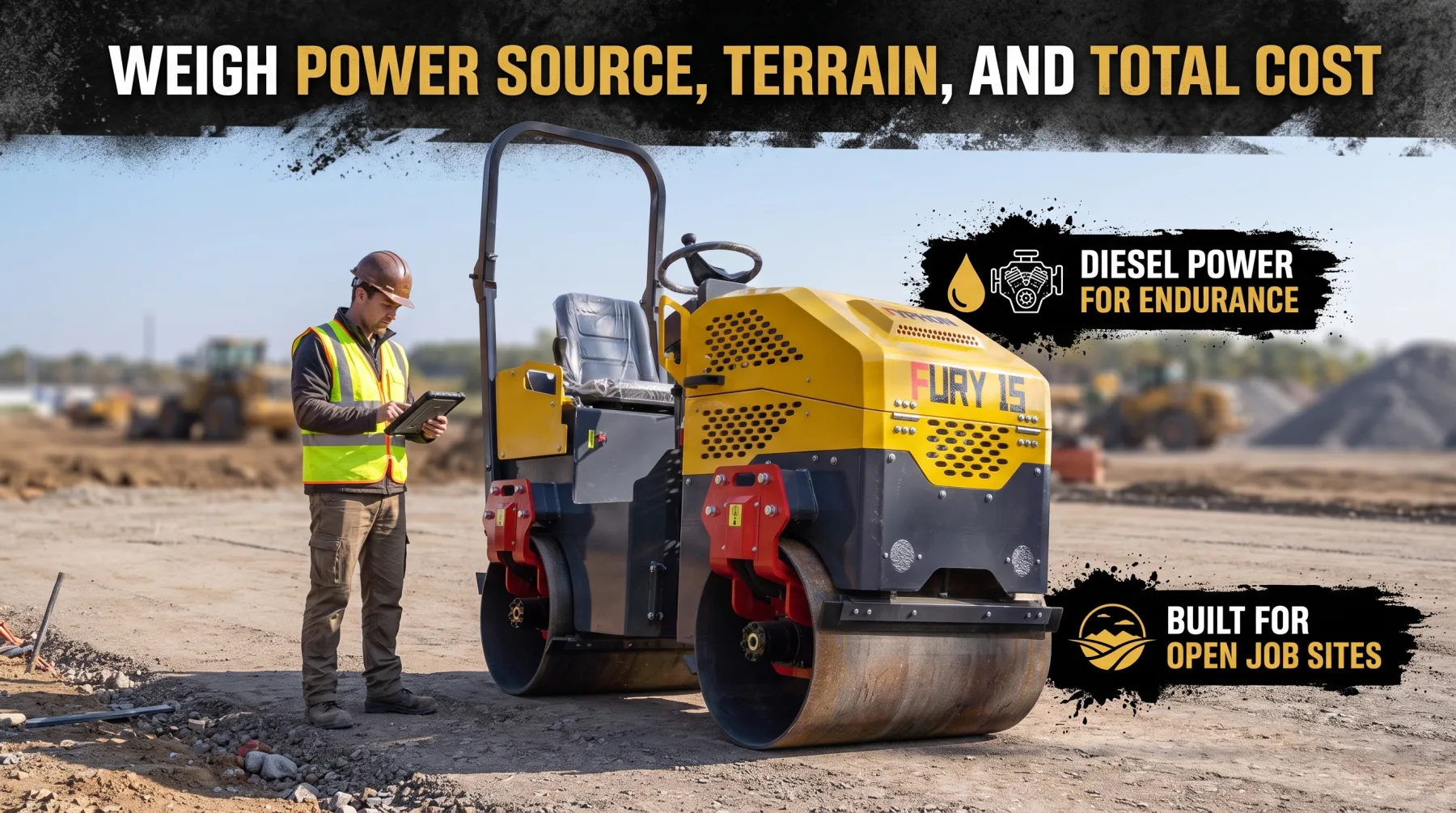
The final layer of the decision ties the machine to how and where it runs, and to what it truly costs over years of service. A roller that suits your material and space can still be the wrong buy if it doesn’t fit your terrain or your budget over time. This is where the purchase becomes a long-term investment decision.
Power Source and Operating Environment
Most road rollers run on diesel, which delivers the power and endurance that sustained compaction work demands, especially on large jobs. For heavy, continuous use on open sites, a diesel machine is usually the practical standard, offering the muscle and run time the work requires. Consider your environment and duty cycle honestly. Smaller compaction tasks and enclosed or noise-sensitive areas may point toward more compact or lower-emission options, while dusty, remote sites reward a machine that’s simple to fuel and service. Match the power source to where the roller will actually spend its hours, not to a general assumption.
Terrain, Traction, and Maneuverability
The ground you work on shapes the machine you need. Flat, prepared sites suit standard rollers well, but sloped, uneven, or rough terrain calls for models with the traction and stability to stay planted and compact evenly. A machine that slips or struggles on grade wastes passes and risks safety. Features like articulated steering, drum drive, and good visibility improve control on demanding sites and in tight quarters. Weigh how much of your work happens on challenging ground, and choose traction and maneuverability accordingly. A machine that handles your terrain confidently is faster and safer over every shift.
Total Cost of Ownership
The purchase price is only the start. Factor in fuel consumption, routine maintenance, wear parts, repair costs, and the availability of parts and service support, since these ongoing expenses often outweigh the sticker price over the machine’s life. A cheaper roller that’s costly to run or hard to service is rarely the bargain it appears. Consider resale value and reliability, too. A well-built machine from a supported line holds its value and spends more time working and less time down, which protects both your schedule and your investment. Weigh new against used honestly: a quality used machine can be a smart buy, while an unsupported one becomes a liability. Takeaway: match the power source to your duty cycle, the traction to your terrain, and judge the machine on total cost of ownership rather than price alone, so the roller earns its keep for years.
Frequently Asked Questions
What type of road roller do I need for asphalt paving?
For asphalt finishing, a smooth drum vibratory roller is typically the right choice, since it applies even pressure and vibration to produce a dense, smooth surface. Many paving crews also value a combination or pneumatic tire roller for its sealing, finishing action on asphalt. Match the machine’s weight to your lift thickness, because too much force on a thin layer can damage the surface rather than compact it properly.
What’s the difference between a smooth drum and a padfoot roller?
A smooth drum applies even pressure across a flat surface and excels at asphalt and granular materials like sand and gravel, leaving a clean finish. A padfoot roller carries raised lugs that concentrate pressure to knead and compact cohesive clay soils from the bottom up, which a smooth drum can’t do well. Smooth drums suit finishing and granular base; padfoot drums suit clay subgrade, embankments, and deep fill.
How do I choose the right size road roller?
Size the machine to two things: the compaction force your material and lift thickness require, and the tightest space you regularly work in. Large ride-on rollers handle highways and open sites but can’t fit confined areas, while walk-behind and compact models reach tight spots and edges. A mid-size machine often covers the widest range of work, so match both power and footprint to your real job list.
Is a diesel road roller the best power source?
Diesel is the practical standard for most road rollers because it delivers the power and endurance that sustained, heavy compaction demands, especially on large open sites. For smaller tasks or noise-sensitive and enclosed areas, more compact or lower-emission options may suit better. Match the power source to your typical duty cycle and working environment rather than defaulting to one choice, and factor in how easy the machine is to fuel and service.
Should I buy a new or used road roller?
Both can be smart, depending on your budget and needs. A new machine offers full life, warranty, and the latest features, while a quality used roller can deliver strong value at a lower price. The key is condition and support: a well-maintained used machine from a well-supported line with available parts and service is a sound buy, while a cheap but unsupported machine can become an expensive liability. Judge total cost of ownership, not just price.
Conclusion
Buying the right road roller comes down to matching the machine to the work rather than the budget, so start by defining your compaction task, soil, and required finish, then choose the drum that fits — smooth for asphalt and granular base, padfoot for cohesive clay, combination or pneumatic for mixed jobs — before sizing the machine to both the force your material needs and the tightest space you run, and finally weighing power source, terrain, and the full cost of ownership across fuel, maintenance, parts, support, and resale rather than the sticker price alone; work through those considerations honestly against the jobs actually filling your calendar, and you’ll buy a roller that compacts to spec, fits every site, and earns its keep for years instead of one you outgrow or fight, and when you’re ready to match the right machine to your work, reach out to a trusted equipment specialist who can pair dependable equipment with the results your projects depend on.